
Solar Electric
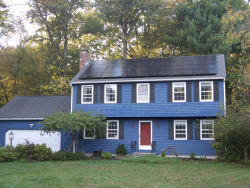
Photovoltaic (PV) panels use energy from the sun to produce electricity. And yes, New England has enough sun for solar! In the past 12 years, residential solar has grown quickly in Massachusetts. As of 2025, after two successful Solarize Needham campaigns in 2014 and 2019, Needham now has over 850 solar PV systems reducing carbon emissions by more than 24,000 tons! You may be a good candidate for solar if your roof has a southern orientation (not necessarily due south) and ideally has sun for at least 6 hours a day. Some homes in Needham have effective systems with an unshaded east- or west-oriented roof.
Interested in Solar Hot Water? See below.
What about the cost?
In the past, rooftop solar was considered to be expensive, but now the price of installation has dropped and there are generous state and federal incentives that reduce the cost further. Some customers pay the upfront cost of purchasing a solar array, but there are also leasing or power purchase agreements that allow customers to have solar panels with little or no upfront payment. (See MassCEC website — scroll down to Ownership and Financing Options.) Please note that the 30% Federal tax credit is only available until Dec. 31, 2025 for residential solar – it has been eliminated by federal legislation signed into law in July 2025).
Once the Federal tax credit expires on 12-31-25 for residential, does it still make financial sense to add solar?
Yes, especially in Massachusetts.
- Electricity is expensive in Massachusetts and costs are expected to rise. Solar panels can reduce or eliminate monthly bills.
- Massachusetts state incentives remain strong. The SMART program, which pays homeowners for the every kilowatt hour they produce, has been revamped and improved, providing a more stable incentive. Also, there is no sales tax on a solar array, and a state tax credit is available for 15% of the cost, capped at $1000, for a primary residence.
- Solar panels have improved. Over the years, solar panels have gotten more efficient, producing more power per panel. At the same time, the price of installation has gone down.
- Solar can increase the value of your home. A Zillow study of several coastal cities found that solar can increase a home’s value by 4%
Where do I start?
Inform yourself. Get an understanding of the basics. The Massachusetts Clean Energy Center (MassCEC) is an excellent place to start, with a comprehensive Solar Energy section on their website that explains everything, including solar technology, state and federal incentives, types of ownership or lease options, and much more. (But note that the incentives section may not be updated to the changes in summer and fall of 2025.)
Contact some installers
A solar installer will have software that allows a quick look online to see if your house might be a candidate. Initial solar consultations at your home are usually free.
- The Massachusetts Clean Energy Center has Tips for Finding and Selecting a Solar Installer.
- The non-profit Green Energy Consumers Alliance (formerly Mass Energy Consumers Alliance), refers its members to EnergySage, an independent web interface that allows users to compare options and get preliminary online quotes from pre-screened installers.
- Talk to your friends and neighbors — more and more people have solar in Needham. Find out what installer they used, and how their experience was.
- Still have questions? Check out Green Needham’s “Energy Coaching Program” described below.
Solar Hot water
Massachusetts Clean Energy Center Technology Description: Solar collectors, mounted on the roof or ground next to a home, absorb heat from the sun and transfer it through a fluid loop into a solar storage tank (typically located in the basement or mechanical room) that stores preheated water. This heated water is then piped throughout the home to showers, dishwashers, sinks, and washing machines. Solar hot water systems can also be used for pool heating and for space heating.
Solar hot water systems are typically sized to provide up to 80% of a home’s annual domestic hot water needs. Since the sun is stronger in the summer, the solar hot water system can provide for all of a home’s domestic hot water needs during that season. In the winter, when the days are shorter, a backup heat source (often an electric resistance heating element) is used to provide additional hot water to meet 100% of a home’s hot water needs.
- Households that do not have sufficient roof space for a solar PV system may still have enough roof space for a solar hot water system.
- There are federal and state incentives available (but the 30% Federal tax credit is only available until Dec. 31, 2025 for residential – it has been eliminated by federal legislation signed into law in July 2025).
- The Solar Hot Water section of the Massachusetts Clean Energy Center website is a good resource.
- Still have questions? Check out Green Needham’s “Energy Coaching Program” described below.
Expired SRECs
Do you have an older rooftop solar system with expired SRECs. Click here to get more information.
Solar Installations in Needham
Click here to read about some recent solar success stories in Needham.
Energy Coaching Program
Would you like to talk to someone knowledgeable about solar PV and solar hot water who is not a salesperson? Green Needham can provide expert advice that is free from commercial bias (we’re not trying to sell you something). We can meet with you in your home or over the phone to help answer your questions.
What we can do:
- Help you determine whether the project makes sense for your house
- Estimate the probable costs and savings for your project
- Determine how the project will affect your carbon footprint
- Discuss how to find contractors for your project
- Help you review contractor proposals and compose important follow-up questions to ask
- Discuss the “next steps” for moving forward with the proposed project
What we can not do:
- Design the work
- Calculate firm costs and savings
- Oversee the construction
So, ask a Green Needham Energy Coach your solar questions.
Resources
Documents
Resources on the Web

|
Learn About Solar Electricity: Mass Clean Energy Center
Good and comprehensive overview of solar electricity technology - benefits of solar, determining if your roof is good for solar, finding an installer, financing, and how solar incentives work. |
|
|
Learn About Solar Hot Water: Mass Clean Energy Center
Good and comprehensive overview of solar hot water technology - benefits of solar, determining if your roof is good for solar, finding an installer, financing, and how solar incentives work. |
|
PV Watts: Estimate Your Home's Solar Potential
With PV Watts & Google Maps you can sketch out a solar system on your home to estimate your potential | |
|
Solar Hot Water Basics
Basics of Solar Hot Water from the US Department of Energy |
